Here are some Frequentely Asked Questions about Rainbow-
Q1. How is a rainbow formed?
Ans- You need a few things to see a rainbow. The main things are rain, you need that rain to be illuminated by bright sunshine, and the rain must be in the right position relative to you. A primary rainbow is always somewhere on an arc 42 degrees around the shadow of your head (called the anti solar point). So the brightly illuminated rain must be in this direction away from you to see a rainbow. For a secondary bow it is 51 degrees around the shadow of your head.
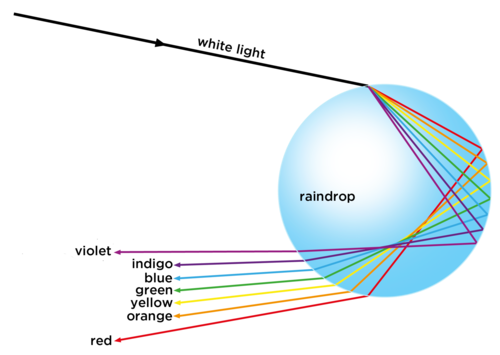
A rainbow is caused by the refraction and internal reflection of light inside rain drops, which results in the white sunlight being separated out into the colours of the rainbow. See the detailed pages which are linked to at the top of this page for a more in depth explanation.
Q2. Why do you see rainbows after it rains?
Ans-You need a few things to see a rainbow. The main things are rain, you need that rain to be illuminated by bright sunshine, and you need to be in a position that the rain lies on the circle 42 degrees around the shadow of your head. So if you get rain from a shower that moves in the direction away from the sun relative to you then you have a good chance of seeing a rainbow. You are more likely to see rainbows on days with scattered shower or storms than on dull overcast rain days.
Q3. Can you see a rainbow anytime of the day?
Ans-If you want to see a natural rainbow in rain, the answer is no. To see a primary bow in the sky above the horizon, the anti solar point, the shadow of your head, must be less than 42 degrees below the horizon (and 51 degrees for the secondary bow). This means you usually can only see rainbows in the morning and afternoons before the sun is too high in the sky. The lower the sun the higher in the sky the rainbow will be.
Q4. Can rainbows appear in random places?
Ans-Sort of. The primary rainbow is some part of an arc 42 degrees around the shadow of you head. But if you call something like a fountain a random place, then on a sunny day you can walk around the fountain until the spray from it lies on this arc, and you will see a rainbow. You can do that for lots of random artificial sources of drops of water in the air, like garden sprinklers, irrigation sprays, and the spray from artificial water falls. To see a secondary rainbow you would use 51 degrees instead of 42.
Q5. How do a rainbow get it's colours?
Ans-A rainbow has colours because the index of refraction of light in water depends on the wavelength of the light, which means the same as colour, of the light, and because sunlight, which is white, is made up of a whole spectrum of colours.
The angle of the rainbow is determined by the minimum angle away from the anti solar point that light from the sun will be scattered, you will also see that this angle depends on the index of refraction. The longer wavelength coloured light, such as red, has a large rainbow angle, then the short wavelength colours, such as blue.
index of refraction of light in water is a measure of the speed of light in water. All colours, or wavelengths, do not travel at the same speed.
Q6. What is the shape of a rainbow?
Ans-Rainbows are an arc at a constant angle from the anti solar point (shadow of your head). For a primary bow this angle is 42 degrees, and for a secondary bow 51 degrees. So the shape is an arc along the circumference of a circle.
Q7. Can you see a rainbow at night?
Ans-Yes, the moon is bright enough to produce a rainbow, and while rare, people do see it. We all just have to get out more at night. Since the moon is not near as bright as the sun, the rainbow produced by the moon at night is much weaker than a rainbow produced by the sun during the day. Our eyes see dim things as black and white, not in colour. So a night "moonbow" will look gray not colourful.
Q8. How far away is a rainbow?
Ans-A rainbow is caused by sunshine on rain. The rainbow is as far away as the rain is. A rainbow can be seen in other sources of water drops, such as fountains, or even dew drops on grass or spider webs. In these cases it is easier to know how far away a rainbow is.
Q9. Can you stand at the end of rainbow?
Ans-A rainbow is not a physical thing by itself. When you see a rainbow you are looking at sunlight that has been reflected and refracted by raindrops. A rainbow caused by rain can get very close. As I say in the question above, the rainbow is as far away as the raindrops. The rain get fairly close but usually the cloud that is producing the rain will block the sun, or the rain itself will, and the rainbow will go away. So you can't really stand at the end of a rainbow.
Q10. Why is red on the outside of a rainbow and blue inside?
Ans-The colours are caused by the different wavelengths (same as saying colours) of light having different indexes of refraction. The maximum angle away from the anti solar point which light from the sun is refracted by the raindrops is greater for red than blue. Thus red is on the outside and blue is on the inside of the rainbow.


 A primary rainbow is always somewhere on an arc 42 degrees around the shadow of your head (called the anti solar point). So the brightly illuminated rain must be in this direction away from you to see a rainbow. For a secondary bow it is 51 degrees around the shadow of your head.
 For a primary bow this angle is 42 degrees, and for a secondary bow 51 degrees. So the shape is an arc along the circumference of a circle.
 Since the moon is not near as bright as the sun, the rainbow produced by the moon at night is much weaker than a rainbow produced by the sun during the day. Our eyes see dim things as black and white, not in colour. So a night "moonbow" will look gray not colourful.
 A rainbow caused by rain can get very close. As I say in the question above, the rainbow is as far away as the raindrops. The rain get fairly close but usually the cloud that is producing the rain will block the sun, or the rain itself will, and the rainbow will go away. So you can't really stand at the end of a rainbow.