

Rainbow, series of concentric coloured arcs that may be seen when light from a distant source—most commonly the Sun—falls upon a collection of water drops—as in rain, spray, or fog. The rainbow is observed in the direction opposite to the Sun.
The coloured rays of the rainbow are caused by the refraction and internal reflection of light rays that enter the raindrop, each colour being bent through a slightly different angle. Hence, the composite colours of the incident light will be separated upon emerging from the drop. The most brilliant and most common rainbow is the so-called primary bow, which results from light that emerges from the drop after one internal reflection.
Although light rays may exit the drop in more than one direction, a high density of the rays emerge at a minimum angle of deviation from the direction of the incoming rays. The observer thus sees the highest intensity looking at the rays that have minimum deviation, which form a cone with the vertex in the observer’s eye and with the axis passing through the Sun. Light emerging from raindrops after one internal reflection has a minimum deviation of about 138° and thus the greatest intensity in the directions forming a cone with an angular radius of about 42°, with arcs (from inside to outside) of violet, indigo, blue, green, yellow, orange, and red.
Here are some different variations of Rainbow-
1)Fogbow
A fogbow is a type of rainbow that occurs when fog or a small cloud experience sunlight passing through them. The droplets of moisture from the fog work to diffract that light.

This type of rainbow is usually found in places where the fog in the air is thin. It can also form above any body of water.
Typically, this rainbow consists of blue, white, and red. The majority of a fogbow rainbow is white, with blue appearing on the inside and red appearing at both ends.
2)Lunar
A lunar rainbow (aka “moonbow”) is another unusual sight. This event occurs on the moon during a lunar month. The moon must be almost fully lit up in order for this type of rainbow to form. When it does, it appears as a white arc.

Lunar rainbows line the moon’s outer rim. They are dull in appearance because the light on the moon is not as bright as the light on the earth.
3)Supernumerary bow
Supernumerary bows are yet another rare type. It occurs in primary rainbows, acting as another band inside of it. This type is created after the sunlight has hit drops of water 1 millimeter in size or less.
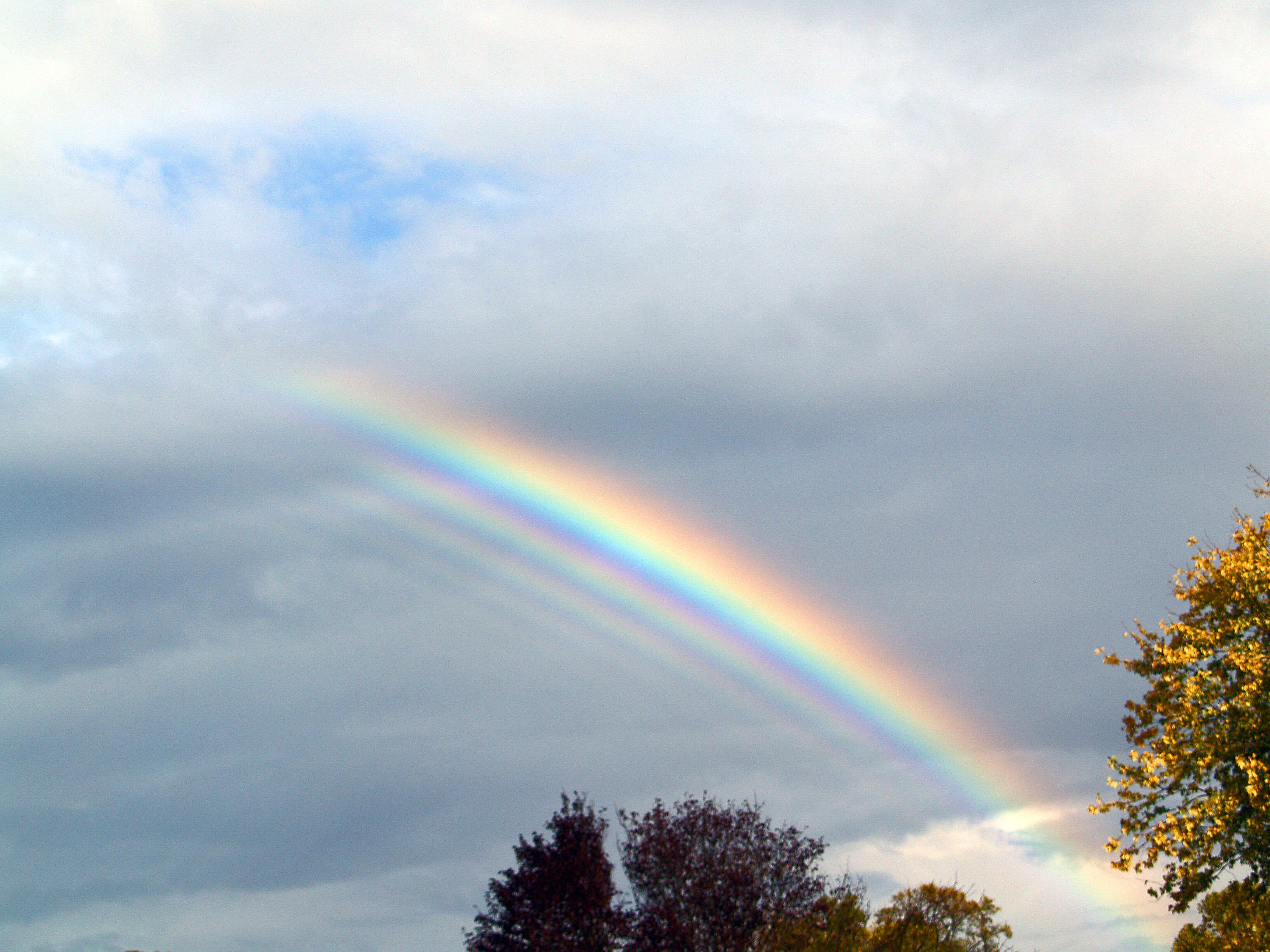 The most unusual thing about supernumerary rainbows is that they don’t use traditional colors. Instead, this type of rainbow features several pastel colors.
4)Twinned
A twinned rainbow is also a rare sight to see. Though they have one base in common, two rainbows are formed, with one being primary and one being secondary. The colors of both rainbows are seen in the same sequence.

When two rain showers occur, the size of the raindrops can lead to the formation of a twinned rainbow. With different shaped and sized raindrops from each storm, one rainbow becomes two. In an even rarer sight, a twinned rainbow can include the formation of as many as three.
5)Monochrome Rainbow
A monochrome or red rainbow is an optical and meteorological phenomenon and a rare variation of the more commonly seen multicolored rainbow. Its formation process is identical to that of a normal rainbow (namely the reflection/refraction of light in water droplets), the difference being that a monochrome rainbow requires the sun to be close to the horizon; i.e., near sunrise or sunset.

The low angle of the sun results in a longer distance for its light to travel through the atmosphere, causing shorter wavelengths of light, such as blue, green and yellow, to be scattered and leaving primarily red. In the lower light environment where the phenomenon most often forms, a monochrome rainbow can leave a highly dramatic effect.
Here are some famous quotes on Rainbow-
1st quote-
“I’d rather see the world as a rainbow than endless shade of gray.”
- Amani Abbas
2nd quote-
“Rainbows are made of small raindrops. Happy lives are made from acts of kindness.”
- Amit Ray
3rd quote-
“God puts rainbows in the clouds so that each of us – in the dreariest and most dreaded moments – can see a possibility of hope.”
- Maya Angelou
4th quote-
“If you want to enjoy the rainbow, be prepared to endure the storm.”
- Warren Wendel Wiersbe
5th quote-
“You’ll never find a rainbow if you’re looking down.”
- Charlie Chaplin